
Introduction: The World Cannot Buy What It Cannot Find
What if the next globally recognised furniture brand is operating in a small workshop today? What if an extraordinary artisan is creating exceptional products but struggling to reach customers beyond the local market? What if a small business has the talent, quality and determination to compete internationally but lacks the digital visibility to make that dream possible?
These are not imaginary challenges. They reflect a reality faced by countless small and medium-sized enterprises, furniture manufacturers, independent artisans, makers and grassroots creators. They build, design, produce and innovate, yet their stories often remain hidden behind the digital noise of a world dominated by established brands, advertising budgets and powerful online platforms.
The problem is not always the quality of the product. Sometimes, the problem is discovery.
In today’s interconnected economy, having an excellent product is only part of the equation. Customers must be able to find it, understand its value, recognise the business behind it and develop enough confidence to take the next step. Without visibility, even the most deserving business can remain overlooked.
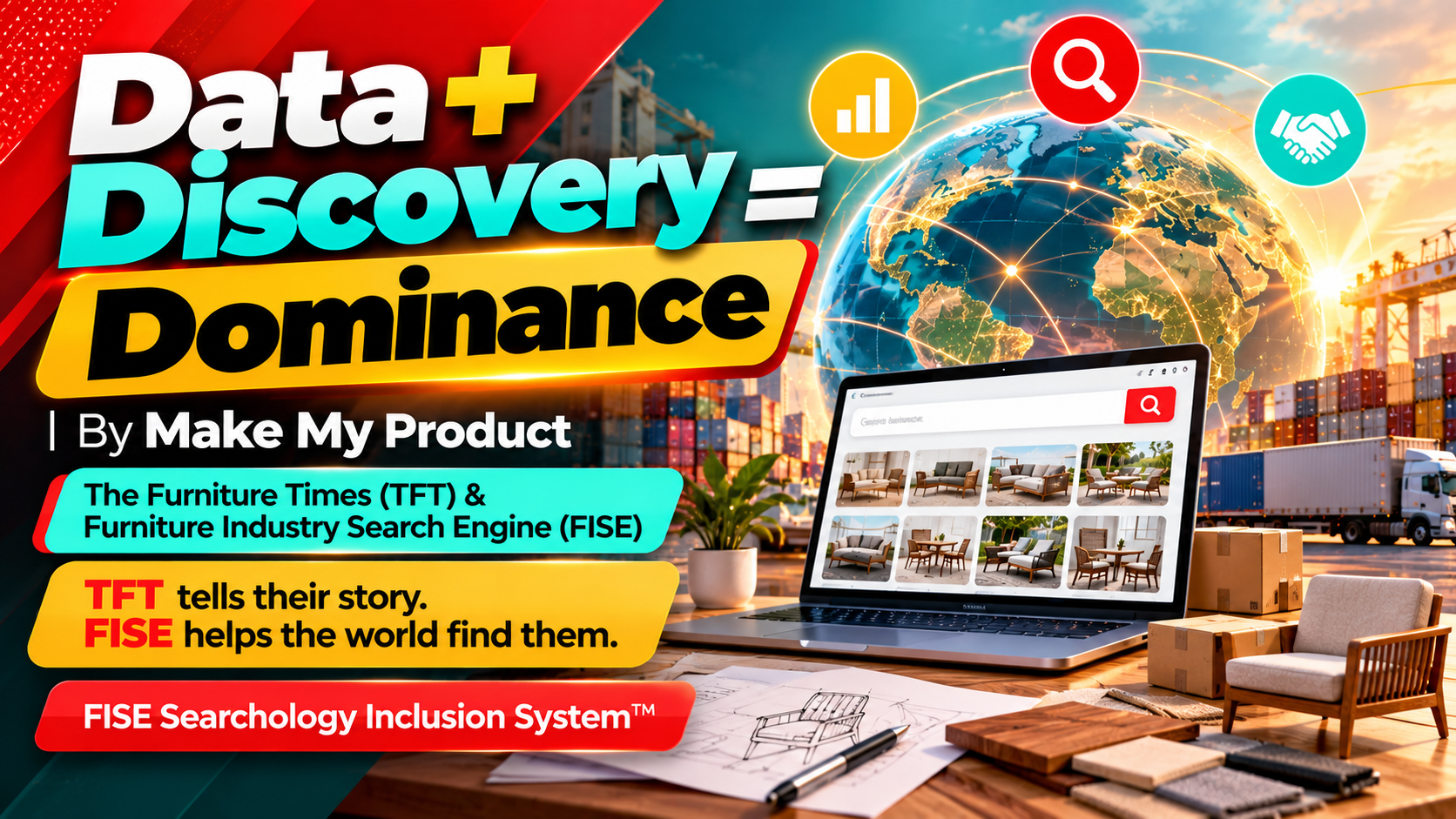
This is where a powerful principle comes into focus: Data + Discovery = Dominance.
Dominance does not simply mean becoming the biggest company in the market. It means becoming discoverable in the right places, relevant to the right audiences and credible enough to turn attention into opportunity. It means helping businesses move from being hidden to being recognised, from being recognised to being considered, and from being considered to being chosen.
Through Make My Product, The Furniture Times (TFT), the Furniture Industry Search Engine (FISE), FISE LIVE and the FISE Searchology Inclusion System™, a broader vision emerges: a more connected digital ecosystem where products, people, businesses and stories can find their place in the global marketplace.
The Visibility Gap: Why Great Products Remain Invisible
Every day, businesses invest their time, money and energy in making products that solve problems, improve homes, support communities and create livelihoods. Furniture makers develop new designs. Independent workshops refine their craftsmanship. Small manufacturers improve their production processes. Artisans preserve traditional skills while adapting to modern consumer expectations.
Yet many of these businesses face the same obstacle: reaching the people who need what they offer.
A social media post may disappear within hours. A website may attract little traffic. A product catalogue may reach only existing customers. A talented artisan may have no affordable way to communicate their story to international buyers. A growing furniture business may compete against established companies with larger marketing budgets and stronger online recognition.
This creates a troubling gap between what a business can offer and what the world knows about it.
The traditional response is often to tell businesses to advertise more, publish more content or spend more on digital marketing. These activities can be valuable, but visibility requires more than producing content repeatedly. It also requires a discoverable digital identity, relevant information, clear positioning and pathways that help people find and evaluate a business.
A product deserves more than a moment of attention. It needs an opportunity to be discovered when a potential customer is actively searching.
A business deserves more than a temporary appearance in a social media feed. It needs a digital presence that communicates who it is, what it creates, where it operates and why its offering matters.
This is the challenge that a discovery-led approach seeks to address.
Data + Discovery = Dominance: A New Way to Think About Growth
Data is valuable because it gives structure to information. Discovery is valuable because it connects that information with people who may need it.
When these elements work together, businesses have a stronger foundation for being found and evaluated.
Consider a furniture manufacturer producing high-quality dining tables. If its business identity, product categories, materials, capabilities, location and contact information are presented clearly, potential buyers have a better chance of understanding what the manufacturer offers. If that information is organised for relevant searches and made accessible through useful discovery channels, the business has a stronger opportunity to reach prospective customers.
The same principle applies to a home-based artisan, an independent designer, a small furniture retailer or a grassroots creator.
Data helps communicate the identity of a business. Discovery helps that identity reach beyond its immediate network. Together, they can support stronger brand recognition, more relevant enquiries and new commercial relationships.
However, dominance should never be confused with a guaranteed ranking, automatic sales or instant international success. Sustainable visibility is built through accurate information, useful content, trust, consistent effort and measurable improvement.
The objective is to make opportunity easier to access.
For small businesses, that shift can be significant. Instead of relying exclusively on personal networks or unpredictable social media reach, they can begin building a more structured digital presence that supports long-term discoverability.
Make My Product: Giving Every Product a Better Chance to Be Seen
Every product has a story. Behind it are decisions, skills, materials, working hours, investment and the ambition to create something useful or beautiful.
Yet a product’s story can be lost when its digital presentation is incomplete, inconsistent or difficult to find.
Make My Product represents an opportunity to put the product at the centre of the discovery journey. The larger principle is straightforward: help businesses communicate what they make, explain why it matters and create a clearer path between their products and potential customers.
For furniture manufacturers, this means presenting products in a way that helps buyers understand design, intended use, materials, specifications and the business behind the offering. For independent makers, it means making craftsmanship and product identity easier to communicate. For emerging brands, it means building a foundation from which recognition can grow.
A product page should not merely exist. It should answer meaningful questions.
What is the product? Who is it designed for? What makes it useful? What materials or processes are involved? Who makes it? How can an interested customer learn more or enquire?
These details help turn a basic product entry into a more informative business asset.
When product information is accurate, descriptive and organised around customer needs, it can also support search engine visibility and help AI-powered discovery tools interpret what a business offers. No platform can guarantee that every product will appear in every search, but better information creates a stronger foundation for discoverability.
The ambition is not simply to put more products online. It is to help the right people find products that are relevant to them.
The Furniture Times (TFT): Every Business Has a Story Worth Telling
Behind every successful business is a story of decisions, challenges, persistence and progress. In the furniture industry, these stories can begin in a family workshop, a design studio, a manufacturing facility or a small business created by someone determined to build a better future.
The Furniture Times, or TFT, represents the storytelling dimension of this wider vision.
TFT tells their story. FISE helps the world find them.
This distinction matters because visibility is not only about product information. It is also about identity, credibility and context.
A furniture manufacturer may have decades of experience but struggle to communicate its capabilities to new buyers. An emerging designer may have an original perspective but lack access to industry audiences. A small business may have overcome significant challenges, yet its achievements remain known only to a limited circle.
Thoughtful industry storytelling can help bridge this gap.
Through relevant features, interviews, business profiles and industry-focused content, a publication can help readers understand the people and enterprises shaping the sector. It can highlight craftsmanship, innovation, entrepreneurial journeys and the practical challenges faced by businesses.
Storytelling also gives potential customers a reason to look beyond a product photograph. It can introduce the people behind the product, the values that guide their work and the experience they bring to the market.
For small enterprises, this kind of exposure can support brand awareness and provide useful material to share with customers, partners and professional networks.
Editorial coverage should always be transparent about its nature and should not be mistaken for a guarantee of commercial success. Its value lies in communicating a business’s story clearly and helping relevant audiences understand why that business deserves attention.
The furniture industry is not made up of products alone. It is built by people. Their stories deserve to be discoverable, too.
FISE: Helping the World Find the Businesses Behind the Products
A story can introduce a business. A structured discovery system can help people locate it again when they need what it offers.
The Furniture Industry Search Engine, or FISE, represents the discovery side of the vision. Its guiding principle is to help connect businesses, products, industry information and potential opportunities through a more organised digital presence.
Imagine a buyer searching for a furniture manufacturer with particular production capabilities. Imagine a hospitality business looking for suitable furniture suppliers. Imagine a retailer exploring new makers, or a designer seeking a potential production partner.
In each situation, the challenge is not simply finding more information. It is finding relevant information that helps the searcher make a better decision.
A useful industry discovery experience should make it easier to understand what businesses offer, identify relevant categories, assess available details and take the next step towards an enquiry or professional connection.
For participating businesses, a well-maintained digital identity can communicate essential information such as product specialities, business location, capabilities, website details and contact channels.
For potential buyers, organised information can reduce the effort required to identify suitable businesses and compare their offerings.
For the broader industry, better discovery can create additional pathways for businesses to connect across locations and professional networks.
FISE should be understood as part of a wider opportunity rather than a promise that every listed business will automatically receive enquiries, rankings or sales. Results depend on the quality and completeness of business information, user demand, the discovery experience and the ability to turn interest into meaningful relationships.
The core idea remains powerful: businesses should have a clearer way to present themselves, and people searching for relevant products or suppliers should have a better way to find them.
FISE LIVE: Moving From Passive Visibility to Active Engagement
Being discoverable is important. Creating opportunities for interaction can take that discovery journey further.
FISE LIVE adds an engagement-oriented dimension to the wider concept. The opportunity behind a live industry experience is to help businesses move beyond static information and create more direct ways to introduce products, share expertise, demonstrate capabilities and connect with interested audiences.
For a furniture manufacturer, this could mean showcasing new collections or explaining production capabilities. For a designer, it could mean discussing design choices and emerging trends. For an artisan, it could mean demonstrating a traditional technique or explaining the value of handmade work.
For prospective buyers, interactive experiences can provide additional context that a brief product description may not communicate.
For participating businesses, these experiences can support relationship-building, product education and more meaningful conversations with potential customers or partners.
The effectiveness of any live initiative depends on its actual features, audience reach, participation model and execution. Nevertheless, the strategic principle is clear: discovery creates an introduction, while engagement creates an opportunity to build understanding.
In a competitive market, businesses need both.
FISE Searchology Inclusion System™: Making Digital Opportunity More Inclusive
The FISE Searchology Inclusion System™ expresses the most socially significant part of this vision: creating a more inclusive pathway for SMEs, artisans, makers and grassroots creators to establish their digital identities and improve their opportunities for discovery.
This is not just a business listing system.
It is a livelihood system, a human impact system, a search revolution, a digital identity movement and a global opportunity engine.
These ideas describe an ambition to connect digital visibility with the real economic lives of people who create products, provide services and sustain communities.
A livelihood system begins by recognising that behind every small business is a person or team whose income may depend on being able to reach customers. For a family workshop, a new enquiry can represent a potential order. For a small manufacturer, a business connection can open the door to a new buyer. For an artisan, a stronger digital identity can help communicate skills that might otherwise remain difficult to discover.
A human impact system recognises that business visibility is not merely a marketing metric. It can be connected to employment, skills, entrepreneurship and economic participation. These outcomes are not automatic, but improving access to relevant opportunities can contribute to the conditions in which they become possible.
A search revolution challenges the idea that discoverability should be accessible only to businesses with substantial marketing budgets. It encourages a more structured and inclusive approach to presenting business information, products and capabilities.
A digital identity movement recognises that many small enterprises need more than a social media account. They need consistent information that explains who they are, what they offer and how potential customers can reach them.
A global opportunity engine expresses the ambition to help businesses reach beyond the immediate boundaries of their local networks. With relevant information, appropriate discovery channels and the ability to serve new markets, a small enterprise may become better positioned to explore international opportunities.
The word inclusion is important. It asks whether the system can serve businesses with different levels of resources, digital experience and market access. It encourages attention to affordability, usability, accurate information and meaningful participation.
A truly inclusive digital ecosystem must do more than promise visibility. It must work to make participation practical and ensure that businesses understand what the system can and cannot deliver.
That is the standard against which this vision should be measured.
Why SMEs, Artisans and Grassroots Creators Need a Different Approach
Large companies often have established brands, professional marketing teams, dedicated sales departments and substantial resources for reaching customers. Small enterprises may have to manage production, purchasing, customer service, accounts and marketing with only a handful of people.
The difference is not necessarily talent or product quality. It is often access to resources and opportunities.
An independent furniture maker may produce excellent work but lack the time to maintain multiple digital channels. A small manufacturer may understand production but struggle to communicate its capabilities through effective online content. A grassroots creator may have a distinctive product but no clear strategy for reaching relevant audiences.
These businesses need practical visibility tools that complement their capabilities rather than create unnecessary complexity.
A structured digital presence can help them organise information. Industry storytelling can help them communicate their value. Search-oriented product descriptions can help clarify relevance. Interactive experiences can help them demonstrate what they do. A reliable contact pathway can help convert interest into an enquiry.
The aim is not to replace every existing marketing channel. It is to make those channels work together more effectively.
A social media post can generate attention. An informative product page can answer questions. A business profile can communicate credibility. A relevant feature can provide context. A discovery platform can create another route through which interested people may find the business.
Together, these elements can support a more consistent and recognisable digital identity.
Search Visibility in the Age of AI: Why Clear Information Matters
The way people discover businesses continues to evolve. Customers use search engines, maps, online publications, industry directories, social media, marketplaces and AI-powered tools to research products and identify potential suppliers.
This changing environment creates an important opportunity for businesses to improve how their information is presented.
Clear product names, accurate business descriptions, relevant categories, complete contact information and useful answers to customer questions can help people understand an offering more easily. Consistent business details across appropriate channels can also reduce confusion.
For furniture businesses, relevant information might include furniture types, materials, intended applications, customisation options, manufacturing capabilities, delivery regions and commercial contact details, where applicable.
For artisans and independent makers, it may include the nature of their craft, production methods, product characteristics and the best way to enquire about availability.
For SMEs, it may include the services they provide, the markets they serve and the problems they are equipped to solve.
This is the practical foundation of search-friendly communication. It is not about repeating keywords unnaturally or making unsupported claims. It is about providing the information a genuine customer needs.
No listing, article or optimisation technique can guarantee a top search position or inclusion in an AI-generated answer. Search visibility depends on numerous factors, including relevance, content quality, technical accessibility, competition and the policies of individual platforms.
Nevertheless, businesses that communicate their identity and offerings clearly give customers and discovery systems better information with which to work.
FISE’s broader discovery vision and TFT’s storytelling approach can complement this principle by connecting organised business information with the stories and details that help people understand a company.
From Being Found to Winning Trust: The Conversion Journey
Visibility matters, but visibility alone is not the final objective.
A business can receive attention without generating enquiries. A product can appear in search results without convincing a customer to take action. A feature can attract readers without creating a commercial relationship.
The journey from discovery to opportunity requires several connected elements.
First, the business must be identifiable. People should be able to understand its name, location, specialities and basic offering.
Second, its products or services must be understandable. Relevant descriptions, specifications, images and explanations help potential customers determine whether the offering meets their needs.
Third, the business must provide reasons to trust the information presented. Accurate details, authentic product photographs, consistent branding, transparent communication and verifiable experience can support credibility.
Fourth, the next step must be clear. Interested people should know how to enquire, request information, explore a catalogue or contact the business.
Finally, the business must respond professionally. Timely communication, realistic commitments, suitable pricing information and dependable customer service help transform an initial enquiry into a relationship.
This is where the wider Make My Product, TFT and FISE concept can become commercially meaningful. Product presentation, storytelling and discovery address different stages of the journey, while the participating business remains responsible for the quality of its offer and its customer experience.
The real objective is not to accumulate views. It is to create opportunities that have the potential to become lasting business relationships.
The Human Impact: Every Discoverable Business Represents a Possibility
Behind the language of data, search and digital identity are people working to build something of their own.
There is the furniture maker who wants to expand a family workshop. There is the artisan hoping to preserve a traditional skill while earning a sustainable income. There is the small manufacturer seeking new commercial relationships. There is the independent designer who needs an audience beyond familiar contacts. There is the grassroots creator who has something valuable to offer but has not yet found the right market.
For these people, being discovered can mean more than increased website traffic. It can create the possibility of a new conversation, a new buyer, a new partnership or a new direction for the business.
Not every opportunity becomes a sale, and not every business will experience the same results. But when access to relevant information improves, people can make more informed decisions about whom to contact and what to explore.
This is why digital inclusion deserves to be considered alongside commercial growth.
A more inclusive business ecosystem should aim to make it easier for small enterprises to establish their identity, communicate their value and participate in markets where their products or services may be relevant.
The long-term ambition is a digital environment in which a business’s potential to be discovered is not determined solely by how famous its owner already is.
How Businesses Can Turn Visibility Into Action
The opportunity begins with practical steps. Businesses do not need to transform every part of their marketing overnight. They can start by building a stronger foundation and improving it consistently.
Begin by defining what the business makes or provides. Use clear product names and descriptions that reflect what customers actually search for. Avoid vague language that sounds impressive but leaves people unsure about the offering.
Create a complete business identity. Maintain accurate contact information, location details, relevant categories and working website links. Where appropriate, explain production capabilities, materials, specialities and the markets the business serves.
Present products professionally. Use genuine photographs, helpful descriptions and relevant specifications. Ensure that customers can distinguish between standard products, customised options and services that require a separate enquiry.
Tell the story behind the business. Explain what makes the company distinctive, how it began, what it creates and the expertise it brings to its market. Keep the story authentic and support claims with verifiable details.
Explore relevant discovery and industry storytelling opportunities. Businesses in the furniture sector can assess whether Make My Product, The Furniture Times and FISE fit their goals, audience and commercial needs. Before participating, review the available features, terms, costs, audience information and expected deliverables.
Make the next step easy. Provide a clear way for interested customers to ask questions, request a catalogue or discuss a potential order. Make sure someone is responsible for responding.
Finally, measure outcomes. Track relevant enquiries, qualified leads, referral sources, website visits and conversions where measurement tools are available. Use the findings to improve product information and focus effort on channels that produce meaningful results.
Visibility becomes more valuable when it is connected to a clear business objective.
The Opportunity Ahead: Building a More Connected Furniture Industry
The furniture industry depends on a wide network of manufacturers, suppliers, designers, retailers, artisans and service providers. Each contributes different capabilities, knowledge and value to the marketplace.
Yet these participants do not always have equal access to visibility or the same ability to reach new commercial audiences.
A more connected discovery ecosystem can help reduce the friction involved in identifying relevant businesses and understanding what they offer. Better organised information can help buyers conduct research. Industry stories can introduce companies and their expertise. Interactive experiences can provide additional context. Consistent digital identities can help businesses communicate across different channels.
This opportunity extends beyond furniture. The underlying principles can also apply to other manufacturing sectors, independent makers, SMEs and grassroots enterprises that need practical ways to present their work.
For this vision to achieve lasting impact, execution matters. Business information must remain accurate. Discovery experiences must be useful. Participation should be understandable. Results should be evaluated honestly. The needs of smaller enterprises must remain central to product decisions.
The ambition is substantial, but its foundation is practical: help people find relevant businesses, help businesses communicate their value, and help both sides move towards meaningful opportunities.
Conclusion: Do Not Let Your Best Work Remain Invisible
The next stage of business growth will not be shaped by product quality alone. It will also depend on how effectively businesses communicate their value, establish their digital identities and connect with the people searching for what they offer.
Data provides structure. Discovery creates access. Storytelling builds understanding. Trust supports decisions. Action turns interest into opportunity.
Make My Product, The Furniture Times, the Furniture Industry Search Engine, FISE LIVE and the FISE Searchology Inclusion System™ bring together a vision centred on these connected principles.
TFT tells their story. FISE helps the world find them.
One helps communicate the human and business story. The other focuses on the discovery journey. Together with product-focused presentation and opportunities for engagement, they represent an approach to making business visibility more structured and inclusive.
For an SME, this can begin with a clearer digital identity. For an artisan, it can begin with a better presentation of their craft. For a furniture manufacturer, it can begin with more discoverable product and capability information. For a grassroots creator, it can begin with a credible way to introduce their work to a wider audience.
The important question is no longer simply whether your business has something valuable to offer. It is whether the people who need it can find you, understand you and take the next step.
Do not wait until competitors become the only names customers recognise. Start strengthening your digital identity, organising your product information and exploring the discovery opportunities that fit your business.
Because the world cannot choose what it cannot find.
Data + Discovery = Dominance. Make your work discoverable. Make your story count. Make opportunity possible.