

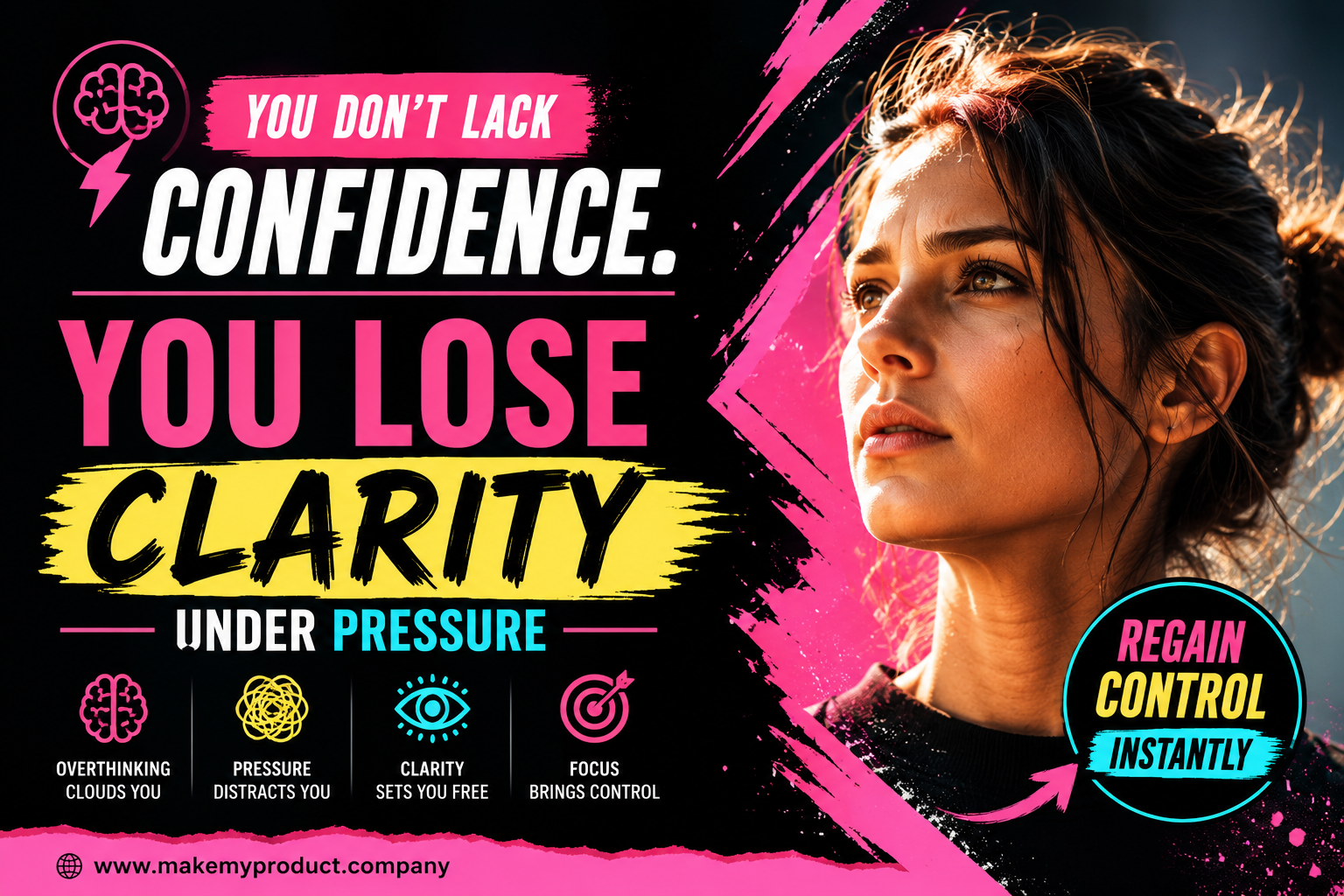
The Illusion of Confidence: What’s Really Going Wrong
For years, people have been told the same thing: “Believe in yourself,” “Be more confident,” “Trust your instincts.” But in real-world pressure situations—interviews, business deals, exams, negotiations, public speaking—that advice often fails.
Why?
Because the problem is rarely confidence.
It is clarity under pressure.
When stakes rise, your brain doesn’t stop believing in you. It starts overloading.
Thoughts multiply. Decisions slow down. Timing feels distorted. You know what to do, but you cannot access it cleanly in the moment.
That is not insecurity. That is cognitive congestion.
And understanding this shift changes everything.
Why Clarity Collapses When Pressure Increases
Under normal conditions, your brain operates in structured flow:
- You think
- You evaluate
- You act
But under pressure, three things change at once:
1. Cognitive load spikes instantly
The brain begins tracking outcomes, risks, judgment, and consequences simultaneously.
2. Time perception distorts
Seconds feel shorter, forcing rushed thinking or mental freezing.
3. Internal dialogue multiplies
Instead of one clear thought, you get competing voices:
- “Don’t mess up”
- “Think faster”
- “What if this goes wrong?”
This is where clarity dies.
Not because you lack ability, but because your mental bandwidth gets hijacked.
The Real Problem Isn’t Fear. It’s Fragmentation
Most people assume fear is the enemy.
But fear alone is manageable.
Fragmentation is what breaks performance.
Fragmentation happens when:
- You know too many options but cannot prioritize
- You overanalyze instead of execute
- You switch between thoughts without commitment
- You hesitate at the point of action
High performers don’t fail because they don’t know enough.
They fail because they know too much at the wrong moment.
Why “Thinking Harder” Makes It Worse
A common mistake under pressure is trying to think more intensely.
But pressure situations don’t reward deeper thinking. They reward simpler thinking.
When you try to “force clarity,” you actually:
- Increase mental noise
- Slow reaction time
- Reduce instinct accuracy
Clarity is not created by effort.
It is created by reduction.
The Shift: From Confidence Building to Clarity Training
Instead of asking:
“How do I become more confident?”
The better question is:
“How do I reduce mental interference when it matters most?”
This shift leads to a completely different performance model.
High performers don’t rely on motivation or emotional certainty.
They rely on systems that preserve clarity under stress.
The 5 Practical Ways to Regain Clarity Under Pressure
1. Reduce the number of decisions in real time
Under pressure, too many micro-decisions destroy flow.
Instead of deciding repeatedly, pre-decide:
- If X happens, I do Y
- If question A appears, I respond with structure B
This removes real-time thinking overload.
2. Slow the input, not the action
Most people panic because everything feels fast.
But clarity returns when input is controlled:
- Pause before responding
- Let silence exist
- Breathe before choosing
Slowing input stabilizes thinking without reducing performance speed.
3. Use “single-thread thinking”
Multitasking thinking is the enemy of clarity.
Replace:
“I should consider everything”
With:
“What is the one most important thing right now?”
One thought. One priority. One action.
4. Anchor your attention externally, not internally
When pressure rises, people become self-focused:
- How am I doing?
- Do I look okay?
- Am I messing up?
This destroys clarity.
Shift focus outward:
- The problem
- The question
- The next step
External focus restores mental structure.
5. Train recovery, not just performance
Most people train only execution.
High performers train recovery:
- How fast they reset after confusion
- How quickly they refocus after a mistake
- How they re-enter clarity after disruption
Because clarity is not constant.
It is recoverable.
The Hard Truth Most People Avoid
You are not consistently underperforming because you lack intelligence.
You are underperforming because you lose mental structure under pressure.
And without structure:
- Knowledge becomes inaccessible
- Skills become inconsistent
- Confidence becomes unstable
This is why some people perform brilliantly in practice but freeze in real situations.
Not because they are unprepared.
Because pressure removes their mental scaffolding.
What Changes When You Fix This
Once you train clarity instead of chasing confidence, you begin to notice:
- Fewer mental blanks under stress
- Faster decision recovery after mistakes
- More consistent execution in unpredictable situations
- Less emotional volatility during performance
You stop trying to “feel ready.”
You start functioning clearly even when you don’t feel ready.
That is real performance control.
Final Insight: Clarity Is the Real Competitive Advantage
Confidence is emotional.
Clarity is operational.
Confidence can fluctuate daily.
Clarity can be trained to remain stable under pressure.
The highest performers in any field are not the ones who never feel pressure.
They are the ones who maintain structure when pressure appears.
And once you understand that difference, you stop trying to feel better…
and start training to think cleaner.